File Conversion
8 Common File Conversion Issues and How to Fix Them
The trend of online file conversion is currently experiencing rapid evolution, fuelled by innovation and cutting-edge
technology at the forefront of this transformation. If your work involves dealing with a large volume of files on a
daily basis, you will certainly agree that at some point, you will need to convert your files.
This requires a high-quality converter capable of converting files across different platforms or applications.
Fortunately, a wide variety of online file converters are available, offering optimum flexibility to choose the one
that best fits your requirements and gets the job done effortlessly.
Many of these converters deliver exceptional results, but it’s crucial to recognize that the file conversion process
isn’t without its risks and challenges. If not fixed promptly, these issues might escalate, disrupting your
workflows and affecting your data integrity.
In this content, we are shedding light on some common hurdles or challenges you might encounter while converting
your files online. And, don’t worry, we will also guide you on how to resolve them without any hassle.
Keep reading!
Common Hurdles During File Conversion & Ways to Fix Them
1. Unreadable or Garbled Texts
Issue: Upon converting a document, the texts appear as unreadable characters or random symbols.
Cause: This results from encoding mismatches between the intended file and source.
Solution:
- Use the "Save As" Feature: In Microsoft Word, just open the problematic document, tap on the option "File," then "Save As." Select a different encoding format, which perfectly matches the encoding of the original file to preserve text integrity.
- Check Encoding Settings: Make sure that both the source as well as destination applications use compatible encoding standards.
2. Missing Characters or Symbols
Issue: There are certain symbols or characters that are absent post-conversion, resulting in incomplete information.
Cause: The intended format might not be able to support specific characters from the source file.
Solution:
- Select Compatible Formats: Choose a target format that can support the whole range of characters in your document.
- Manual Correction: Upon conversion, thoroughly review the document and manually insert the missing characters.
3. Formatting Discrepancies
Issue: The converted file often exhibits misaligned paragraphs, inconsistent spacing, altered fonts, etc.
Cause: Differences in formatting capacities between file types could lead to such issues.
Solution:
- Use Premium Conversion Tools: Count on a robust or already reputable online file converter to retain the formatting fidelity.
- Adjust Formatting Post-Conversion: Get prepared to make the necessary manual adjustments to restore the original layout.
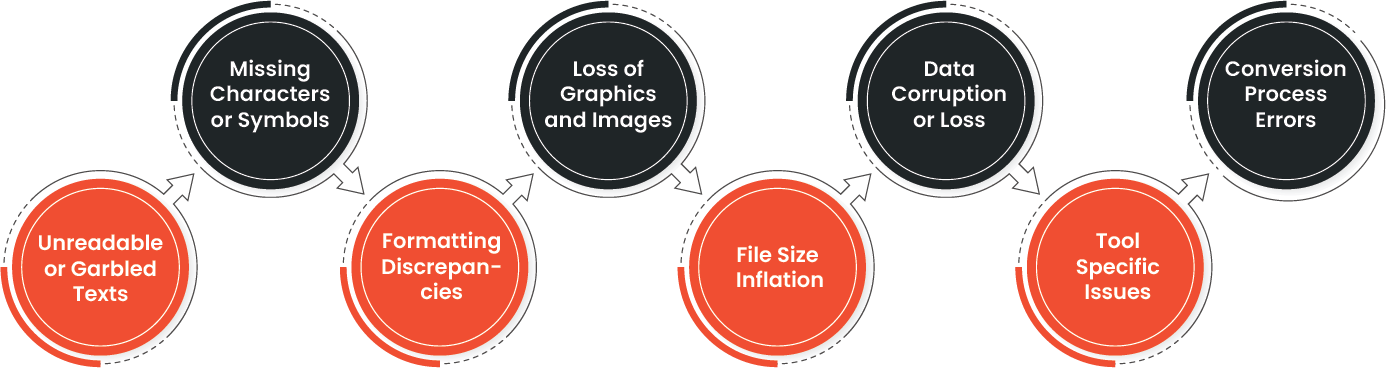
4. Loss of Graphics and Images
Issue: Graphics or images are distorted or missing upon online conversion.
Cause: Not every format handles embedded media constantly, resulting in alterations or omissions.
Solution:
- Pick Appropriate Formats: Make sure that the intended format supports embedded graphics and images.
- Verify Before Conversion: Don’t forget to check the overall compatibility of media elements with the intended format beforehand.
5. File Size Inflation
Issue: The transformed file is a bit larger than the original, consuming more storage space
Cause: There are some formats that have comparatively less efficiency, leading to larger file sizes.
Solution:
- Select Efficient Formats: Convert to formats known for better compression without the loss of quality, such as optimized image formats or PDF.
- Use Compression Tools: Upon online conversion, you must employ file compression software or tool to reduce size.
6. Data Corruption or Loss
Issue: Critical or important data is lost, or the file gets corrupted during the process of conversion.
Cause: Incompatible formats or improper conversion processes could lead to data integrity issues.
Solution:
- Backup Prior to Conversion: Don’t forget to create a copy of the original file to keep the risk of data loss at bay.
- Use Reliable Software: Count on a robust and premium-quality online file conversion tool to reduce the risk of corruption.
7. Tool-Specific Issues
Issue: Some tools or software applications might not support certain file formats, leading to unexpected errors.
Cause: Compatibility-related hurdles often arise due to the use of proprietary formats or outdated software versions.
Solution:
- Update Software: Ensure that every application involved in the online conversion process is updated to support a more extensive array of file formats
- Choose Universal Formats: Whenever possible, consider converting files into widely accepted formats such as JPEG, PDF, or other common standards to avoid compatibility issues.
8. Conversion Process Errors
Issue: Errors may occur during the process of online conversion, halting completion.
Cause: This could result from tool-related glitches, unsupported file features, or insufficient system resources.
Solution:
- Troubleshoot Application or Software: Restart the system or application to resolve temporary glitches or issues.
- Check System Resources: Make sure that your system meets the necessary needs for the conversion app, tool or software.
The Final Takeaway
Online file conversion, while extremely common, is fraught with potential risks or hurdles that could disrupt productivity and affect data quality. By understanding these common challenges and putting the suggested solutions into practice, users can easily navigate the conversion process without hassle, ensuring reliable and accurate outcomes. Staying updated and using premium file conversion tools are key to eliminating conversion-related problems.